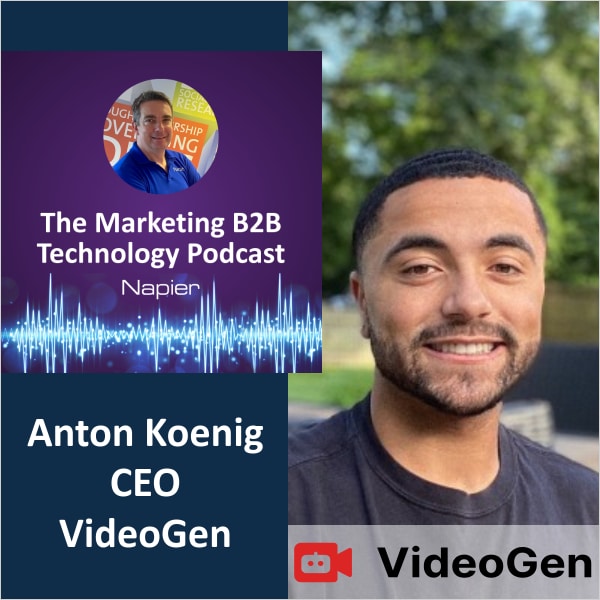
Anton Koenig, Co-Founder and CEO of VideoGen, an innovative video editing platform that utilizes AI technology and highlights how AI now supports semi-professionals and professionals in producing high-quality video content.
Anton emphasizes the importance of combining AI-generated content with user-driven editing to enhance video quality and engagement. The episode also covers common mistakes marketers make in video production and offers insights into the future of video content creation.
- Marketing B2B Technology on Apple Podcasts
- Marketing B2B Technology on Spotify
- Marketing B2B Technology on napierb2b.com
About VideoGen
Founded by Anton Koenig and David Grossman in their college dorm rooms, VideoGen has grown to over 4 million users across 190+ countries. They are backed by the world’s top early-stage investors including Y Combinator and Rebel Fund. As video becomes the dominant form of communication, their mission is to democratize video creation with AI, helping millions express themselves and share ideas in the process.
About Anton Koenig
Anton Koenig is the co-founder and CEO of VideoGen. He previously interned at Amazon Web Services and left the UMass Amherst Computer Science program to build VideoGen full-time. He began freelancing in graphic design in middle school, which led to video editing, web design, and ultimately web development.
Time Stamps
00:00:41 – Anton’s Background and the Origin of VideoGen
00:04:36 – Current Features and Functionality of VideoGen
00:10:15 – VideoGen’s Impact on Marketing Strategies
00:11:59 – Common Mistakes Marketers Make with Video
00:13:36 – Balancing Quality and Quantity in Video Production
00:16:22 – VideoGen’s Marketing Strategy and Promotion
00:17:56 – Future of Video Creation and AI Integration
Quotes
“The mistakes that we see is not copywriting themselves, just totally trusting the AI to write for them.” Anton Koenig, CEO at VideoGen.
“The main driving force for more demand for video is that the cost to stream video is going down and that more people’s devices are supporting video.” Anton Koenig, CEO at VideoGen.
“Creating videos is like a super important skill now and not a lot of marketers know how to do it.” Anton Koenig, CEO at VideoGen.
Follow Anton:
Anton Koenig on LinkedIn: https://www.linkedin.com/in/antonckoenig/
VideoGen website: https://videogen.io
VideoGen on LinkedIn: https://www.linkedin.com/company/videogen/
Follow Mike:
Mike Maynard on LinkedIn: https://www.linkedin.com/in/mikemaynard/
Napier website: https://www.napierb2b.com/
Napier LinkedIn: https://www.linkedin.com/company/napier-partnership-limited/
If you enjoyed this episode, be sure to subscribe to our podcast for more discussions about the latest in Marketing B2B Tech and connect with us on social media to stay updated on upcoming episodes. We’d also appreciate it if you could leave us a review on your favourite podcast platform.
Want more? Check out Napier’s other podcast – The Marketing Automation Moment: https://podcasts.apple.com/ua/podcast/the-marketing-automation-moment-podcast/id1659211547
Transcript: Interview with Anton Koenig and VideoGen
Speakers: Mike Maynard, Anton Koenig
Mike: Thanks for listening to Marketing B2B Tech, the podcast from Napier, where you can find out what really works in B2B marketing today. Welcome to Marketing B2B Technology, the podcast from Napier. Today, I’m joined by Anton Koenig. Anton is the co-founder and CEO of VideoGen. Welcome to the podcast, Anton.
Anton: Thank you for having me, Mike.
Mike: It’s great to have you on. We like to learn a little bit about our guests first. So maybe you can tell me a little bit about your career and why you decided that you needed to find VideoGen.
Anton: Sure. The story behind VideoGen started actually way back when I was in middle school. That’s when I met my co-founder or now co-founder. We’re in a tennis academy together and we were actually doubles partners and competitors. So we became friends through tennis. And at the time, there wasn’t a lot of middle schoolers interested in programming and building web apps and also video editing and graphic design and sort of digital creation. So we also became friends over this shared interest. And we worked on some web applications together. I built like a small social network. He built, I remember it was, uh, like an online music editing software. And we just launched a bunch, a bunch of small apps, sometimes working together and sometimes just sharing ideas. And we always wanted to build something that would have been useful to us kind of back in the day when we were just starting out, figuring out how to create stuff online. So. Fast forward to 2023 or 2022 actually, late 2022. Him and I are still in college, but we’re, you know, kind of nearing the end of college. We’ve gone through the big tech internships. And we sort of realized that that’s not like the direction we wanted to go of like working at one of the fan companies as a software engineer. We wanted to build a startup, build something that we’re passionate about, that we could talk to our users and see the real impact of. So we just started brainstorming a ton of ideas. If you remember, this was right before ChatGPT had launched, but there was OpenAI had released a GPT-3 and they had like a sort of a private platform that we were lucky to get off the wait list early. So we were like one of the first people to get access to GPT-3. And we were using this model. We were trying to start a company. David was actually working at, he was interning at this video editing startup. I was working with, I had kind of a web design thing at the time. And we were like, okay, video editing is something that we understand. It’s something that, you know, we’ve done before ourselves and we understand the technology behind it. And we saw that using the models like GPT-3, we can actually make it a lot more accessible for the average marketer, the average communicator or educator, where certain tasks are just very tedious right now, where you have to manually source stock footage, you have to manually record voiceovers, you have to go inside of the timeline and organize all your layers in extreme detail. and the state-of-the-art video editors of the time, and still today, will have just so many buttons all over the place. It’s very overwhelming. So there wasn’t like one aha moment where I could point to to say, okay, this is when we had the idea for VideoGen, but we were in the midst of brainstorming. We saw this opportunity with GPT-3, And we decided to just sit down for six months and work on the first version of VideoGen, which we launched in 2023.
Mike: That sounds, I mean, really exciting. Lots to ask about, but I mean, maybe the best thing is to talk about, you know, what’s happened between 2023, when you created this video editor using early versions of ChatGPT and what VideoGen does now. So can you give us a little explanation of what VideoGen can do today?
Anton: So the biggest difference between what we initially did and what we do now is that we actually support all of the video editing functionality you would expect, but the AI still can create your first draft. VideoGen 2023 was very simple. You know, you would sign up and then you type in a little prompt. it would find stock footage for you, it would generate a narration, and then it would put everything together in a video. But once you had the video, you couldn’t really edit it. So this worked for some very small creators or people that are extreme beginners. But today, we serve semi-professionals and professionals who will use AI to get their first draft. It’ll bring them 75% there. And then they’ll go inside of the editor and refine all of the small details. And we find that that’s sort of the best balance, where similar to if you use a template, it’s sort of much better to use a template or now this AI-generated version than it is to build something completely from scratch. But with AI, the video that we create for you is much more unique, and we have The main workflow that our users do today is they’ll type in a prompt, it’ll write a script for them, they’ll edit the script, and then they can also refine the layouts on the side, so it’s sort of like a wireframe storyboard. And then you submit the script, and it’s going to find and source stock footage or AI-generated footage and clip it in place. It’s going to create an AI narrator or an avatar, which is more common in a communication content. And then it will also find like music and captions and all the things you’d expect from a video. So that’s kind of the most popular workflow. The main way we’ve evolved is just by adding more editing features and more professional tooling.
Mike: And so I guess, you know, the big difference between VideoGen and maybe some of the large AI models is that you’re adding this editing feature. So that presumably is still the critical bit, particularly if you’re looking, for example, as being a professional marketer and you need a video to be perfect. Is that right?
Anton: Definitely. I will say so. A big reason that we actually decided to add these editing features is we started using VideoGen internally for our own marketing and we realized okay, this is super cool, but in order for it to actually be useful, we need to be able to do things like, you know, add our own brand colors with like our own CTA at the end in a very specific format, right? Or we need to be able to change like this one line of copy to, you know, just sound a little bit different so that we can A-B test. So it’s things like that, which without having those like really standard now, video editing functionality, it’s pretty difficult to use in a professional setting. If you see like ChatGBT, or I know like if you go to Bing now, they’ll have like a create video button. A lot of those tools are much more consumer facing. So they’re not going to offer any of the video editing functionality. But if you want like a very short clip, and that’s all you need, then they’re great for that.
Mike: And so, I mean, who is it who’s using VideoGen? You kind of alluded that the consumers can probably get that, a lot of what they need free of charge. So, I mean, is this enterprises? Is it marketers? Where do you see the biggest group of users?
Anton: Yeah. Right now we focus on semi-professionals or prosumers. So this is pretty wide range. But our largest segment is marketers and semi-professional marketers who maybe their job title isn’t marketer, but they end up having to do a lot of marketing. You know, huge range within that. We’ll see B2B marketers, B2C marketers. Yeah. You’ll see like content creators who are trying to build an audience to sell a product. Another large segment is training and communications and like corporate education, where there it’s a lot more like slow paced content. People are creating five to 10 minute videos trying to educate on a topic. And then the list kind of goes down from there. So marketing, Communication, education, we sort of grouped that together because the video formats are similar. And then it’s content creators, consumers just trying to play around with the latest tool. We have some media companies actually. It’s one of the largest media companies in the world uses us as well. So one of the exciting things with video is that So many different people are using video for so many different things. And we actually couldn’t have expected that when we first got into VideoGen.
Mike: I mean, I totally agree. A lot of marketing is about video now. It’s a huge move to video. I mean, is there an area that you see people particularly getting benefit from VideoGen in the marketing space? Is it around social or something else?
Anton: Yeah, mostly paid social. I would say that’s typically where you have like the most constraint on video production for context. Like when we were running our paid social, we would produce like between 10 and a hundred creative assets a week and a certain percentage of those we want it to be video. So producing that is just impossible now with a human, right? You need, people to create certain assets, and then you need platforms like VideoGen to repurpose those and create different variations that you can maybe test. We also see a lot of organic marketing, which some of it has been surprisingly successful. The reason I say that is the videos that VideoGen produces now they’re still like relatively formulaic, like more for an ad or like a training video. And our thought was that with organic content, you sort of need to have like a person talking engagingly in front of the screen. But we have seen a few channels grow their audiences to 10,000 or, you know, 50,000 or 100,000 subscribers. And then they’ll sort of sell a product on the back end of that. But I think paid social is where we see the best recurring use case right now.
Mike: One of the things I’m interested is, as marketers, we’re all getting to grips with videos, and particularly in B2B, my sector. It’s a relatively new thing to have to generate all this video. I mean, what are the mistakes that marketers make when they’re trying to generate video?
Anton: The mistakes that we see is not copywriting themselves, just totally trusting the AI to write for them. It’s a little bit counterintuitive because the whole idea is that the AI is going to do the work for you, right? But there’s sort of a balance where the AI is going to give you that first draft. It’s going to make it so you don’t have to write something completely from scratch and spend an hour just getting started. But the best marketers are still going to go in. They’re still going to make the small tweaks, you know, change the phrasing of this, that intro hook sentence to just be a little bit more engaging or make this part a little more concise. Like it’s just small edits that make something really engaging and professional. And even though we, you know, LLMs have gone really far, you still need a marketer to go in and write copy. That’s like really engaging and true to the brand. So yeah, I’d say the biggest mistake is not doing like those few basic edits to take the video from like, okay, to, okay, now it’s like super professional and engaging.
Mike: And that’s very interesting, because I think a lot of people are talking about volume when it comes to AI, you know, AI’s great strength is speed. But actually, it sounds to you, to me, like you’re saying with video, quality is probably the important thing. And spending some time up-leveling that quality is more important than producing a 51st video.
Anton: Well, so I’ll put a caveat here. This is more of the mistake that we see with our users, who, if we look at the average marketer working with video, The average one is spending hours or sometimes days per video. Whereas our average user is producing a video in five minutes or less. If you try the platform, it’s like the first video is like 15 seconds on average. So that can train some of our users to go like a little too fast. I don’t think it’s good to spend five hours on a video if you’re trying to run a marketing campaign, especially on paid social, where you need like a large volume to AB test. I also don’t think it’s good to spend 15 seconds on a video. So I think there’s an ideal of like, okay, I’m going to spend 30 minutes editing this up, refining it. And then I’m going to move on to the next one. And then at the end, we’ll have a package of like 10 videos that we can use for a campaign.
Mike: And what about the way you generate video? I mean, should marketers be using a combination of video they shoot themselves, stock, and also AI generated? Or is it better to focus on one particular source?
Anton: I think it depends a little bit. We’re usually mixing, I mean, our users will usually not mix stock and the AI generated footage. they’ll usually use either stock plus uploaded assets or they’ll use a fully AI generated footage. I don’t know if there’s a hard rule on that. I don’t think that you can succeed with a mix. Like one of the things that people will do is they’ll use maybe stock footage for 99% of their video. And then if there’s like one missing clip, they’ll generate an AI clip. Yeah, I think it depends. One thing we’ve seen work for us when we would create ads is we would mostly use, I mean, cause we’re a software company. So the types of assets that we needed were recordings of people using the software or it would be like a motion graphic of the software. So it’s something that you can’t find in stock footage or generate really with AI. So what we would do is we’d upload our own clips of the motion graphics or the screen recordings. And then we would use that for the whole like back half of our video. But our like first hook just to grab the user’s attention would be an AI generated clip. So it would be like an engaging hook. AI-generated effect that’s something that you could never imagine creating without an animation team. And then it switches to the pre-made assets that we’ve created.
Mike: And it’s interesting you talking about the assets you make, Anton, because presumably your marketing strategy is built around showing the capabilities of the product by making videos. Is that how you do it? And how do you promote that?
Anton: So right now, most of our, we’re not really investing in so much marketing right now. It’s pretty much all word of mouth. But there was a period, especially when we were starting, we were investing pretty heavily on all the popular platforms, you know, Meta, Google. We actually didn’t do TikTok, but YouTube. And we found that It’s sort of a mix. A lot of the best ads for us were just people that were looking for video production software. So they didn’t necessarily go to like a video platform like Facebook or like Instagram reels to find that. Maybe they would go to YouTube. and then they would search. So then it would sort of be like a tutorial video or like a more helpful video that guides them and then also converts them. So it’s sort of, I guess like long form video for us was more successful.
Mike: No, that makes a lot of sense. I’m interested, you know, let’s talk about the product specifically. What do you see happening with, you know, video? It’s doing things today that probably people didn’t imagine five years ago. So how do you look for the future? And how do you, you know, think about what the features of VideoGen might be in five years time?
Anton: Yeah, so I think our strategy, which has been since day one, is we’re just going to focus on the immediate pain points of our customers. And if we just do that every day, every month, every year, and continue to deliver value, then we shouldn’t have to think too deeply about what is the grand economic trend here. I think that it’s going to depend a lot per industry. So it’s hard for me to give like a very kind of concise answer. It’s a question I get a lot, like what is the future in five years look like for AI video creation? I think for marketers specifically, there’s just going to be more demand for video. And that’s something that we’ve already seen over the past five years and 10 years. And I actually think the main driving force for that is that the cost to stream video is going down and that more people’s devices are supporting video and that the cost to produce a video is going down. I think AI is an accelerating force for that, but I actually don’t think that it’s changing like the fundamental trend, which is that you know, 10 years ago on a lot of devices, it’s actually pretty difficult to, like, you couldn’t imagine something like TikTok, where you could just scroll through a bunch of one minute videos forever and never really have to worry about lag or bandwidth. We had Vine, which was limited to It was like six seconds. And then they shut it down because they were losing money because the storage costs were so high. So the technology industry in general has made like a ton of advancements on storage, on video encodings. And I think AI is just an accelerator for that. So more people are going to be watching videos. More people are going to be creating videos. And that’s going to lead to more competition. So you need to like the quality bar definitely goes up for all the creators. It’s also going to lead to a lot of interesting trends and memes and viral clips that like right now, I mean, we sort of got like one viral clip or one meme per year, maybe two. But as people consume more and more video, I think that there’s going to be like many, many pockets where you have these like trends pop up. And yeah, it just leads to like a lot of quick motion in these in these consumer markets.
Mike: Yeah, it sounds really exciting and I’m sure people will be interested to try the product as well. Before we talk about that though, there’s a couple of questions we’d like to ask everybody who is a guest on the podcast. So the first question, Anton, is about advice. And it’s what’s the best marketing advice that you’ve ever been given by someone else?
Anton: The best marketing advice? So this is always a tough question because I don’t want to give broad advice, especially, you know, our platform is pretty unique. Like most of our customers who are marketers, they have different challenges than what we have marketing our product. So that’s just the nature of being like an AI software company. There’s only so many companies like us. best marketing advice? Yeah, that’s a tough question. I don’t know if I can think of like one specific example, I guess. Yeah, just provide value, like value-driven marketing. It’s not like one piece of advice, but there’s definitely like a whole ecosystem of how do you give value upfront to then convert that into a customer later? And we’ve definitely seen that work on our end. with not just like content, but also with the product itself. Like, you know, if we give a little freebie, like you can get a free video or you can get some free AI credits, then that helps us build trust with the customer. And then they’re much more likely to convert and stay later on. Yeah, I can’t point to like one specific quote, though.
Mike: No, but I mean, I love that idea of making sure you give value. I think that’s great advice. The other question we ask is, if you were talking to someone who was, for example, a graduate just entering marketing, what would you tell them to help them grow their career?
Anton: So there, it would definitely depend on the type of marketing they’re interested in. That’s kind of the first question I would ask them. Yeah. I mean, probably the most important thing is like that you’re doing something that you’re passionate about and that you can do for a very long time. So yeah, let’s say I’m trying to like imagine a certain type of marketer. I mean, I would definitely tell them to learn how to create videos. You know, creating videos is like a super important skill now and not a lot of marketers know how to do it. And it’s becoming easier, but it’s still pretty hard and you still do have to know how to edit. So I would tell them to learn how to create videos. I would tell them to understand how I guess SEO works on like a very detailed level. I guess that’s one thing where David and I, David’s my co-founder, us having been programmers and building a lot of websites, we have like a good understanding of how search engine works and how they discover your platform. And we find that those same principles are sort of getting reapplied, even as we see things like chat GBT come onto the market. You still have the same principles of how does like a program look at your software and your website and try to index it.
Mike: Yeah, that’s awesome. Thank you, Anton. Really, really useful advice. Before we finish, I’m sure people are listening to this and they’re thinking, you know, I want to try VideoGen or maybe they’ve got some questions. So where’s the best place for them to go to find out more information?
Anton: The best places probably are just our website, videogen.io. And you can also just look up VideoGen and it should show up. Yeah, you can sign up for free and try it. We do have for some like larger customers, if you’re interested, you can find, we have like a, on our pricing page, a contact sales button, but I recommend that people just try it for free and see if you’re interested.
Mike: I think that’s great. That’s a real confidence in the product to say, try it. And then if you think it’s a good product, then contact us. So that’s awesome. Anton, this has been really interesting. I know a lot of marketers, particularly in B2B, are worrying about how they can generate more videos. So thanks for explaining how VideoGen can help.
Anton: Yeah, and thank you, Mike, for having me.
Mike: It’s been a great conversation. Thanks for being a guest on Marketing B2B Technology. Thank you. Thanks so much for listening to Marketing B2B Tech. We hope you enjoyed the episode. And if you did, please make sure you subscribe on iTunes or on your favorite podcast application. If you’d like to know more, please visit our website at napierb2b.com or contact me directly on LinkedIn.