
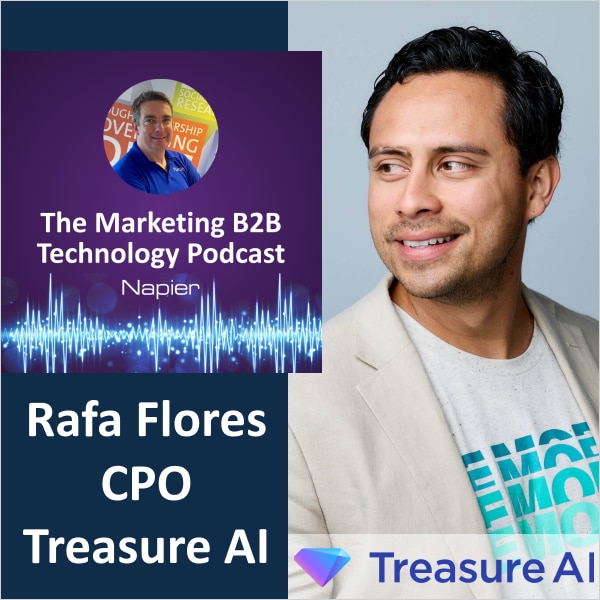
The Evolution of AI in Marketing: A Discussion with Rafa Flores at Treasure AI
Rafa Flores, Chief Product and Growth Officer of Treasure AI, joins the podcast to talk about his career path from engineering recruiter to “boomerang” leader returning after six years away, and Treasure Data’s rebrand to Treasure AI. Flores says the shift is an evolution based on the company’s machine-learning and predictive heritage, its technical DNA of using AI internally, and a desire to create a lifestyle-like community brand.
He explains Treasure AI Studio, which orchestrates CDP and activation in plain English across web and mobile, enabling faster troubleshooting, campaign deployment, and real-time insights. Flores argues first-party data remains a “goldmine” but must be activated incrementally with governed access; how AI helps answer questions quickly but requires guardrails, discusses fear and overemphasis on speed/cost versus value and predicts growth of “digital workers”.
- Marketing B2B Technology on Apple Podcasts
- Marketing B2B Technology on Spotify
- Marketing B2B Technology on napierb2b.com
About Treasure AI
Treasure AI is the agentic experience platform helping the world's most loved brands finally activate the customer data they already have. Founded in 2011 and backed by SoftBank, the company spent 15 years quietly building the infrastructure behind some of the most recognizable names in retail, automotive, CPG, and financial services — before rebranding in 2026 to reflect what it had always been building toward. Named a Forrester Wave Leader for B2C CDPs, Treasure AI unifies fragmented first-party data into a single living customer profile and puts AI to work on it in real time, on behalf of human marketers who set the strategy and make the calls. The result for brands like Nestlé, AB InBev, Stellantis, and Condé Nast is measurable: millions in recovered media spend, significant revenue generated, and marketing teams that finally get to go home on time.
About Rafa Flores
Rafa Flores is the Chief Product and Growth Officer at Treasure AI, where he leads product strategy and growth with a simple conviction: the best technology gives people their time back. A builder by nature and a father of four, Rafa has always believed that progress is personal — that the products worth building are the ones that free someone up to be more present, more creative, and more human. That belief drives everything from how he runs his teams to the unconventional call he made to give away free access to a platform traditionally reserved for Fortune 500 companies, a bet that raised eyebrows and is already showing results. He brings that same bias toward progress to every stage he walks onto.
Time Stamps
00:00 Welcome and Guest Intro
00:39 Rafa’s Career Journey
01:53 Returning to Treasure Data
03:25 Move at Speed of Now
04:12 Rebrand to Treasure AI
07:22 Lifestyle Brand in B2B
09:57 AI Studio Use Cases
12:37 First Party Data Goldmine
16:29 AI Hype and Real Value
18:38 Digital Workers Ahead
20:31 SaaS Future and Guardrails
23:59 PLG Try Now Campaign
26:02 Advice and Wrap Up
Quotes
"It's not just about how much time AI can save you, it's also about how much revenue it can drive for the business." Rafa Flores, CPO at Treasure AI.
"Digital workers are about better supporting the human in the loop." Rafa Flores, CPO at Treasure AI.
"The biggest mistake is everyone wants to rush to deploy AI." Rafa Flores, CPO at Treasure AI.
Follow Rafa:
Rafa Flores on LinkedIn: https://www.linkedin.com/in/ref2019/
Rafa Flores on Forbes: https://www.forbes.com/councils/forbestechcouncil/people/rafaelflores/
Treasure AI website: https://www.treasure.ai/
Treasure AI YouTube: https://www.youtube.com/@TreasureData
Follow Mike:
Mike Maynard on LinkedIn: https://www.linkedin.com/in/mikemaynard/
Napier website: https://www.napierb2b.com/
Napier LinkedIn: https://www.linkedin.com/company/napier-partnership-limited/
If you enjoyed this episode, be sure to subscribe to our podcast for more discussions about the latest in Marketing B2B Tech and connect with us on social media to stay updated on upcoming episodes. We'd also appreciate it if you could leave us a review on your favourite podcast platform.
Want more? Check out Napier’s other podcast - The Marketing Automation Moment: https://podcasts.apple.com/ua/podcast/the-marketing-automation-moment-podcast/id1659211547
Transcript: Interview with Rafa Flores at Treasure AI
Speakers: Mike Maynard, Rafa Flores
Mike: Welcome to Marketing B2B Technology, the podcast from Napier. Today I'm talking to Rafa Flores. Rafa is the Chief Product and Growth Officer at Treasure Data. Welcome to the podcast, Rafa.
Rafa: Thank you for having me, Mike. I'm excited to be here. I think it's gonna be a good conversation
Mike: I, certainly hope so. I'm looking forward to it. Thank you so much for, for joining us as a guest. You've got a really interesting career. We always ask people to give a background to their career to start off with. and you've worked for Treasure Data twice. So do you want to tell us a little bit about your career and why you, left Treasure Data and then decided to come back?
Rafa:Yeah, no, it's a, it's a very good question
Rafa:and I, I do wanna take it a little bit of a step further and start about just the start of my career. I came out of school with business and engineering degrees, and at the time I, I, I decided I was gonna be an engineer. However, I didn't know how to get a good job, right?
Everybody was competing for jobs, and so I said, "Hey, you know what? I'm actually gonna go and become an engineering recruiter." people thought I was crazy at the time, Mike. They said, "Hey, what are you doing? You're leaving a lot of money at the table." And maybe I was, maybe I still am. but I wanted to work with the top hiring managers.
I wanted to get a sense of what it was like to work at these companies, what it was like to work for them, right? What I needed to have on a resume to get through the initial screening. And so I did that, right? That's the path I took. I set three months of a hard stop that I said no more than three months, otherwise I'm gonna be stuck on the people side of the aisle forever. And I did that. I quit on month three. I said, "No more." I got one hire, so I was a, a pretty bad recruiter. But it set me up for, for the rest of my career, and I'm, I'm very happy and glad that I did that. of Teradata being a moo-boomerang, I am a boomerang. I never thought that I would be a boomerang, but here I am.
I was with the company for a little over six years. He-helped build the company, right? Uh, so it's very dear to my heart. And at the time when I left,, I I took on a different job, and I, I never thought I would come back. But thing led to another, from one dinner to a Thanksgiving text to here I've been in the seat for a little bit, north of one year.
it's been a fascinating year. the speed of innovation that we've become, it's, it's fantastic, and I like to think we're ahead in terms of market dynamics. So I, I, I am proud and happy to come back, and I have a fantastic team that I work very closely with on a day-to-day, so
Mike: That's so positive. I, you know, I love the way that you're prepared to admit that maybe it's the right time to go back somewhere even though you weren't naturally a boomerang. I'm interested whether the Rafa who's a recruiter would have recommended a company to take someone back like that
Rafa: I would've said, "Don't take this guy back." No, you know, it's... W- when I had the conversation with, with our current CEO, Kosuke Yota, he... I, I said to him, "Why do you want me back," right? He said, "I need somebody who can just focus on executing and getting the job done, who has a vision And, can get it done. You're a doer. I know you could do it," right? And we've done it, right? I, I think it was the right decision. It was the right decision for me to join. I don't know if he feels that it was the right decision to rehire me, but was definitely the right decision for me to join. I brought in a lot of, peers who, you know, worked with me in the past and they're part of my teams now.
And we've really just... we have this new motto for the year. It's our annual theme, move at the speed of now, right? With everything going on in the market, do we move the speed of now, but how do we give a meaning to the term now, right? The sense of community. What does now mean to you?
Is it now in this second? Is it now in where you are in your life, your context? And, in the context we're in, I think coming back has allowed me to just give people a little bit of hope that, hey, we're gonna be just fine. AI is here to stay, but how do we actually make the best of it and, help our customers be superhumans or users, but also ourselves, right? My job as a leader is to make sure that people can get their next best job after this job, not currently, right? I'm a firm believer in that. And so, that's what I'm here to do, Mike. That's what I came back for, for the job
Mike: is more now than AI. and obviously Treasure Data is now positioned, you know, very much as an AI tool rather than just a customer data platform. So tell us, you know, why do you do that, and what did that require in terms of strategy?
Rafa:Yeah, no it was a hard bet, I can tell you that. It was a lot of closed-door meetings, a lot of punching on walls and things just to make sure we made the right decision. But as of April 20th, we became Treasure AI, so we, rebranded the company. We're still in the middle of it, right? There's a lot of, very cool and exciting things that I cannot announce yet, but you'll see a lot of PR in the next couple weeks. But it's a different company now. In terms of the why, I think there's two big pieces to it. AI is here to stay. I'm a firm believer in that. I don't think it's going away. I was a part of the Internet of Things with Arm Holdings, and to me that was different, right? There was no credible use cases with that. there's a lot of credibility in terms of how much it can actually save you time, but also how much it can actually drive revenue for the business, right? And so it's not going away. So when it comes to moving at the speed of now in, in AI, we can actually go and have, a position as a company where AI is not just generative AI, but it's a combination of machine learning gen AI, is our definition of true AI. And so when we look at our company, we're trying to make the choice of do we pivot to become this Treasure AI? It's not really a pivot. It's more of a step in the journey. We've been a machine learning company. We've done predictive. We've offered next best product. We offer next best action. The models are there. We're bringing in new models in, right? And that's our definition of AI. So that's the first element of it. We saw it as an evolution, we didn't see it as a pivot, which I think that's the best way to do it. If it had been a pivot, I don't think that's the right decision, right? And I think unfortunately, a lot of companies right now are pivoting to rush to bring AI in, and those companies are probably gonna be going under i-in the foreseeable future. the second element as to why we made the choice is we have a very technical DNA as an organization. We're adopting AI in-house. want to be a company or a business that can actually go and drink their own champagne. So when we put AI in the name, are we agentic by design ourselves? And the answer is yes, right?
All the way from our accounting officer, to our marketers, to, to our product managers, right? To UX designers now prototyping and pushing PRs, right? Pull requests. It's fascinating to see that. And so if you bring the element of it's been an evolution of our definition of AI, not just the market noise, who we are as the DNA of a company, that's Treasure AI, right?
And that's why, to me, it was the right decision. I think the, third piece that I will add too is when I land in, and I gotta tell you this story 'cause it's, it's always-- I'm sure everybody goes through this, but when I land at San Francisco Airport to go to our headquarters, I live down south of Los Angeles, I see about 1,000 billboards on my drive in an Uber between the airport and headquarters, and they all talk about AI, right?
And AI this, and AI superhuman, take your jobs away, don't fear AI. There's a difference between what everyone is doing and what I wanna do. From a brand perspective, I wanna become a lifestyle brand, and it's hard t- to do that, right? We're not Nike We're not shoes. We're not-- We don't sponsor Steph Curry. I want you to feel that if you come and use our product, you're part of something greater, right? You're-- You have this sense of community. You have the sense of I'm a part of a community of builders, of innovators, right? Of people who are making the best of AI. That also comes with the Treasure AI name, and that is something that I think we're, gearing towards.
We're not there yet. But that is where my focus is right now, to make sure that Treasure AI means something to the world, not just to us.
Mike: I love that. I love the idea of like a, y- a lifestyle brand i- in the world of B2B being actually part of something. I mean, can you explain a little bit more about how you're doing that? Is that getting interaction between users? W- what are you doing? That's a, that's a really interesting thing to talk about
Rafa:Yeah. So it all starts in the little details, right? So I'll tell you. Swag, the term swag, right? technology company gives out swag. They go to conferences, they give out a hat. They give out a custom boot nowadays. They do whatever they can to stand out. For us, it's different, right?
When I said to the team and the company, "I want us to be thinking from a lifestyle brand day to day," right? How can we fit their lives and not them fit their lives into our product? We changed our swag. actually have air Now, the air freshener scents are called AI, artificial intelligence. And our thing to the market is, hey, you can touch AI. You know what AI sounds like, what it looks like. can you smell it, right? That's lifestyle. I know it sounds cheesy, but that is lifestyle, right? And the reason I bring that as an example is it's, it's all in the little details, right? If you focus on all the little details, you slowly but surely start to become more of a lifestyle brand.
People will see you differently, And, and ultimately, that's the whole objective of when I build on the product side, right? I, I oversee the growth side. "I I also oversee the product. So left side, right side of the brain. But on the product side, we can build now to ensure that somebody works less, Forget 8:00 to 5:00. If somebody can work 8:00 to 1:00 because of our, tools underneath the hood, why not, right? We've done our jobs. And so if you have that methodology, plus you focus on the details on the growth engine side, you slowly but surely will become more of a lifestyle brand, right? People will care.
People will notice you. You will stand out. just a different way of doing business as a tech company
Mike: I love that. I, I, I think that's a great approach to, you know, building a bit more of an emotional relationship with your customers. I'm gonna go and focus a little bit more though on the, product and, and how do you, you know, let that person that starts at 8:00 actually finish at 1:00 rather than work through to 5:00?
I mean, what problems are you solving for customers today that you maybe couldn't solve two years ago?
Rafa:Yeah, I mean, l-let's, let's talk about just the, verticals we serve and, and ultimately the technology vertical we, sit in, right? Or historically have sat in. work very closely with financial services, healthcare, media, automotive, CPG, retail, right, hospitality entertainment, you name it, publishers. And one of the big components of that is historically been a customer data platform, right? So if you look at those verticals, you look at the vertical that we come in as a vendor, it's often viewed as complex and, and hard to deploy, right? I'm trying to change that, and I can now because of AI and the products that we have.
We just came out with a new product called Treasure AI Studio. Treasure AI Studio is the super orchestrator at the top that allows you to orchestrate your activation suites plus the CDP, AKA the data foundation, all in plain English. You couldn't have done that as a marketer six months ago, right? You just couldn't. Fixing a broken data pipeline, how are you gonna do that without the technical chops? are you gonna do that and get prioritized by IT? You may have a two, three-week time span that you're still gonna be waiting for them to fix that, that broken pipeline. you could do that now with Treasure AI Studio, right?
And so those are some of the use cases that we actually are able to solve for today via our products that we couldn't offer to the market e-even a few months, past, how do you deploy a campaign from the ground up in five minutes? How can you be at the gym? I'll tell you a personal story. We have Treasure AI Studio on, on web, desktop, and mobile. the beauty of it being on mobile is that I can, as a CPO and CJO at this company, I, I usually go to the gym at five in the morning every single day. That's just... I can't sleep. Sometimes four if, if they let me in, right? but I like to sit on the StairMaster, and I just open Treasure AI Studio, and I ask the questions that I need to know answers right before I start my day. "Hey, show me the latest pipeline growth numbers," right? "Show me green space. Show me account health for the following three accounts because I have a call with them later today when I check my calendar." I can get those answers. Those are some cool use cases, right? If you are a CMO, and you can actually, in a proactive way, go to your team and say, "Hey, here's what I'm seeing. Here's a little bit of direction. Go about your day," it's fantastic. You're moving, again, at the speed of now, right? In real time. You, you look at the signals at the right time
Mike: I think that's interesting. I, I mean, it's kind of a reflection of the importance of first-party data now, and I think a few years ago, you know, third-party data was, was really the key thing. A lot of privacy regulations come in. My first question is, is first-party data really that valuable now?
Is that really where people need to focus?
Rafa:First-party data is a goldmine, right? I don't think that has changed. I think the mindset has to change in terms of how you actually deploy the value of that goldmine. And here's what I mean by that. I've sat in so many panels, webinars, fireside chats, you name it, you have all these big brands and CDOs talking about the value of first-party data the process they're gonna go through and what their expectations are. And what I always tell them is, "This all sounds great," right? It's like writing a book. You wrote a beautiful book. But in execution, you're gonna be sitting there for two, three years still looking to deploy your second or third use case, Because you're gonna uncover the next broken pipeline, the next missing source.
You're gonna uncover some potential regulation that changes or comes in. You're never gonna actually deploy the, the true value of that data. so with AI coming into the mix, you can actually deploy much faster, right? And, and we have this saying at the company that AI is only as good as, as what you feed it, right?
Garbage in, garbage out. First-party data sits at the crux of that. to make sure that you leverage it with purpose. try to solve everything at once. Just solve what's your most critical business problem, and then scale it, right? Add another source. Change a table. Check a different pipeline. try to do this pretty book and then try to actually go and have somebody read it. Guess what? They're gonna be stuck on page one. They're not gonna get past that, right? And you're gonna churn. You're gonna bring a new vendor, but you're gonna have the same book. So then you're gonna churn again, and it's gonna keep, uh, it's gonna be a continuous cycle.
So it's not the vendor problem. It's you are the problem
Mike: That's really interesting because, you know, as an agency, I see a lot of people, with a lot of first-party data that frankly they're not using or they're using very badly. and it's interesting that, you know, you're saying it's not the tool, it's really about, making sure you can implement those use cases.
So do you think AI really is the key to making it easier to, make use of that data?
Rafa:Well, and no. I'll tell you the no, and the no is not so much a no, more of a caveat. The, the challenge with, with first-party data is access, right? You cannot just give everyone the same degree of access. Privacy regulations, governance, it's extremely, extremely critical now more than ever because people tend to want to have more access with AI. And so that's the no part, right? You have to ensure with first-party data and using the data, you can't just democratize data. You have to do it in a governed way, something that we take very seriously here because we serve global brands, right? And so we wanna make sure that we can remain compliant and keep, keep them true to it as well. However, the reality is people can actually ask deeper questions and get an answer right away, right? You can go today and ask a question in Trust your AI Studio, "Hey, why is this channel actually not sending more than X number of emails when my segment has the following set of profiles?" Well, it's because you're missing a source, or you are missing X signal, And then the more answers you get, the more likely you are to go and explore and use more of the data?
right? There's a question of whether you should or have access, right? that's just the reality. And so because you can get an answer, at the tip of your finger so much faster, you are more likely to be able to use more of that goldmine
Mike: that's interesting. the opportunity for AI to actually help people make use of that data is, clearly a great opportunity. But do you think there's areas where maybe companies are overestimating the benefit of using AI, particularly agentic AI?
Rafa:I- in many ways, right? And, and I'll tell you the, the biggest mistake, and this is my opinion, this is not a Treasury Eye opinion, but this is me, Rafa Flores’ opinion. Everyone wants to just rush to deploy AI, right? You're seeing that. There's pressure all the way from boards down to C-level and, and it just trickles down. There's two factors you're gonna run against. Number one, there's a credible fear of AI? in general. So if you're in the board and your CEO says, "Yes, that sounds great. We're gonna go And do X," that person may not. They may be scared of even them losing their job. And it-- and this fear just tenfold as you go down.
The amount of liv- mid-level management that's scared and says, "Yes, boss, I'm gonna go and talk to this vendor," and then they delay those conversations by a month, and then they push the meeting out, and then it's six months later and they still haven't engaged, is they're doing that purposely because they don't wanna risk losing their job.
And so there's that fear element of it, right? And then on the other side, the mistake being made is everyone's thinking about, how do we actually save costs? How do we work faster? I have not once, Mike, promoted anyone at any company or team that I've led due to how fast they work. Never. I have never sat in a, panel or a meeting where we're discussing promotions and said, "Well, this person works faster, so they're gonna get the promotion." No. It's all about adding value, right? And so when it comes to overestimating AI, overestimate the fact that still have to add value, right? It's not about just saving costs or working faster. It's you can work as fast as the speed of light, but if you're not bright enough in the room, guess what? It's not gonna be enough, right? And so I think that is kinda overestimated many times. how do you measure success of AI? It's not just operational efficiency. It's you ultimately have financial attainment
Mike: I mean, I think that that's a really, like, straightforward, down-to-earth approach. You know, you've gotta get the value. But obviously, we've all seen great benefits from AI. So, on the other hand, let, let's look at something more positive. Are there some examples of, you know, enterprise AI deployments or applications that you think are gonna happen over the next couple of years that are really gonna surprise people?
Rafa: I think digital worker, and I know it's a hard pivot to go from, "Hey, we're talking about fear of AI" to digital worker. Digital worker, I think the problem with the concept of it is when people hear the term digital worker in the sense of AI, automatically think we're saying, "You are going to lose your job because an agent's gonna take it away from you." not what we mean right? worker, what we mean is, at least us at Treasure AI, "Hey, the job that you are performing when you go to sleep," because you need to sleep. Human beings need to sleep. It's a requirement. You eat, you sleep, and you drink water, right? There needs to be something in place that's running autonomously, and that will allow you to have a better morning the next day and the next day and the next day.
And so you are going to see a big rise in the term of digital workers in the field in better supporting the human in the loop so that it's a team effort, right? And we're seeing that. We are seeing that quite a bit at Treasure AI. We have a lot of companies that we serve today saying, "Hey, let's talk about digital worker. Let's ensure we can leverage it," right? How do we make sure we can bring it into the mix with teams while still them being the governance in place behind the machine? so I think you're gonna see the rapid rise of that. unfortunately, I think some vendors and companies are gonna take advantage of it and, and just say, "Hey, by 2035, all of you are gonna be out of jobs." I don't think that's gonna be the case, right? I don't think banks want all of us to lose our jobs 'cause no agent's gonna pay our mortgages. it's us getting a paycheck. but I, I do, see a big rise in the, the concept of digital workers
Mike: that's interesting. I think what we're seeing in the market is there's really this question of how big an impact there's gonna be. And, you know, you've said digital workers are gonna be a big thing, but you don't see them replacing all our jobs. I mean, a- as a SaaS company, you, you've obviously seen some of the valuations of SaaS go up and down, and particularly down recently as there's this, idea that maybe vibe coding is gonna replace SaaS.
So do you think SaaS has still got a future? and if you were starting again, you know, would you start, you know, helping people build something custom, or would you build a SaaS product?
Rafa: I would not build a SaaS product. I'll just tell you that out of the gates, right? And the reason I wouldn't build a SaaS product is there, there's no such a thing anymore as an ankle biter. your competitors, big or small, they can catch up to you very quickly, I think here's what makes the difference. What makes the difference is how do you actually guardrail AI to ensure that you could still serve a purpose and suffice to a, a business need in a safe manner, right? Because sometimes you can run into some serious risk. I'll give you a great example. In the worlds of CDPs, the segments are the engine to everything, right?
It tells you who the right people are with the right signal and how to best target them. if something happens to that segment because you have vibe coded in, right? You have vibe coded an application, you put people in there, and suddenly the guardrails you have on there, you then think that somebody could potentially go and a bad actor come in and pull that information away. Well, guess what? You may suddenly just have to shut down your operation because you're gonna get a major lawsuit, right? And you're gonna lose that lawsuit. You never thought of it, but you will, right? And so guardrails are extremely important, and I think that's the big difference, right? You could be a SaaS company looking to evolve to being an AI-first company. that will win are the ones that have proper guardrails. And you're seeing that with some of the big names out in the market. But you're also seeing how some of those companies still struggle, We just saw the big Anthropic news with the US government. Now, take it or leave it, you could see that in many different shapes or form, but it, it, it happened, right?
And so do you guardrail to prevent some of that? It doesn't matter who you are, that will come your way
Mike: I think that's a great point. And I mean, I guess you're saying that even when you look at, you know, a CDP platform, which doesn't seem to be necessarily something that has to be super robust and reliable, actually that really matters, because when it goes wrong the cost is high
Rafa: Exactly. Right? And, and I think this is a... Going back to your first question of was it the right decision to come back, there was a major announcement last week from Databricks, right? They've been a partner of ours, data warehouse. Obviously, a lot of our customers have Databricks on the technical side, and they use us as their martech source of truth. But now Databricks is saying, "Hey, we have customer data lake. We're the next CDP," right? Sitting within the data warehouse. What they're realizing, at least from my perspective, is it's not that easy to build a CDP because now you're building something for a non-technical user that you have no experience with, right?
And you have to now gain credibility there. And you also forget about that there's historical friction between the marketeer or the CMO and the IT teams, and now you're forcing them to kind of be in one place. It's just different, right? And so, everyone wants to be a CDP. I have this running joke with some of my executive friends that everyone wants to be a CDP.
Nobody knows what it's like to actually have to build a CDP, because when something goes wrong, it could go really wrong. And if you don't know what you're doing, that could really affect many, many different things down underneath the hood
Mike: That's such a great point. I mean, I'd like to kind of finish this discussion on, on data and, and CDPs with something a bit positive. So I'm interested to know, have you got an example of a particularly innovative or creative or effective campaign that you've seen that, leverages technology and data?
Rafa: From us or just in general in markets?
Mike: just wherever, where something you think is great
Rafa: Well, I'll, I'll tell you, and this... I don't think I'm great by any means, but I am gonna give my teams a shout-out here. One of the things that I I decided to deploy a couple months ago, it just came to my mind. I said, "Well, what if you could actually go and try a CDP as soon as you land on the website," right?
The concept of PLG. Hard to do. It's not easy to do it. There's a reason nobody had done it before. But I believe that nowadays when you go and you think of a campaign, people wanna... They wanna test it right there and then, "Don't just send me an email. Don't just show me a, a demo on render. I actually wanna see it.
Give it to me. I wanna try it. If it works, I may buy it. If it's, if it doesn't, then maybe not." And if it doesn't exist, then I'll know right away if you... If, if I ask you, "Hey, I wanna try it right now," and they say, "No," I know that it doesn't exist. And so we decided to roll out PLG on our website. If you go to treasure.ai, you can actually do it now.
You can actually go, click Try Now, and it takes you to your own CDP deployment, You can bring in your own data. It's governed, it's safe. Or you can actually use some sample data that we have, depending on the vertical and the persona you are. And you can go and, and run and, and get an email with the latest information you need or how to deploy your next best journey, right, for omni-channel orchestration. To me, those risks bets worth taking at this point in time the expectation of who a buyer is and what they're looking for
Mike: I love that. And I, and I think that that's different to what a lot of people say on the podcast. and it's great that you're not only calling out one of your own products or, or your own campaigns, but you're also talking about something that's really about building an experience for a customer. So thank you for that
Rafa: it's always fun to build the next best campaign. You gotta be different nowadays if you wanna stand out
Mike: this has been fascinating, Rafa. I mean, before I let you go, there's a couple of questions that we like to ask everybody. and the first one's really simple. What's the best marketing advice that someone's given to you?
Rafa: It just happened. I was at Cannes at the Festival of Creativity, and I was having a conversation with a friend, and we were walking this person through a, a new product offering regarding paid media AI suite, right? How do you actually optimize this big dollar spend that you have for all your ad requirements? And this person said, "We are at an era where performance marketing and brand marketing are just becoming one. not really separate. They need to become one. However, the concept of brand marketing versus performance marketing still stands where marketing is there to build a brand that people love, you are there to drive conversions to secure targets as a business," right? I thought that was just such good advice 'cause oftentimes we try to separate the two, and we report separately on them, and we speak of them. But you cannot build a brand you love without knowing what you need to actually secure in the background, and vice versa. How are you gonna secure targets if you don't build a brand you love?
and how do you bridge those two together even have a dashboard that shows you our lovability score, but also our pipeline, right? those don't really exist. You don't really think of it that way. well, I-I'm changing my mindset, I tell you that, after that conversation, and now I wanna have a dashboard that shows me that, right?
Tell me, do people love our brand, and are we actually gonna be able to hit quota? me in one single view
Mike: I think that's a, that's a really fascinating idea there. And, um, you know, obviously the more people love the brand, the easier it is to get performance marketing to actually deliver results. So I think that's brilliant. the other question we like to ask people is around the future, and I mean, at Treasure AI, you're, you're right on that bleeding edge of, this rapid change we're seeing in marketing.
if you were talking to a young person who maybe just graduated from college, was looking to start a marketing career, what piece of advice would you give them?
Rafa: Yeah. And, and we're seeing this, right? I mean, always go on stage and I say, "Hey, don't fear AI." And then I will get an answer from, from the audience of, "Well, how can I not when kid cannot get a job fresh out of college?" And it's a reality. I'm a parent of four, right? I, I completely want my kids to, to be able to be employed when they finish, but I do want them to go to college. But what I will tell a young marketer who is just graduating, looking for their first job, go and actually use AI. Go learn all about it. Go speak, reach out on LinkedIn to all the AI experts, reach out to yourself, myself, whoever, right? to get advice so that you can actually develop your own perspective of how AI can be applicable to the jobs that you want to apply for, so that when you go through that interview process, you come to the table with something. Don't let companies put everything at the table and ask you, "Hey, what do you think? How can you actually add value to us?" tell the company, "Here's how I can add value, because here's the three or four different key use cases that I see of how AI can be applicable to me at this point in time with the limited context that I have." That would be my advice to them.
Mike: I think that's brilliant. Bring something to the table is probably, you know, one of the best bits of advice I think you can give a young person.
this has been fascinating. I feel like we could have spent a lot longer talking about AI, and Treasure Data but if somebody wants to find out more information, where's the best place for them to go?
Rafa: Try the product. The best way is to try the product. So going back to the PLG concept on web, treasure.ai, go in there, you'll see a big button right in the center of the screen saying, "Hey, move at the speed of now. Do you wanna try now?" Try now, right? And if something's broken, you don't like the UI, something's missing, me on LinkedIn, let's have a conversation.
feedback is good feedback
Mike: That's amazing that the head of product's being, you know, giving you an offer to actually give product feedback directly. I love that. Thank you, Rafa.
Rafa: No, thank you for having me. What a pleasure
Mike: Thanks so much. I've really enjoyed this. Thanks for being a guest on Marketing B2B Technology.
Rafa: Thank you. Happy to come back anytime
Mike: Thank you

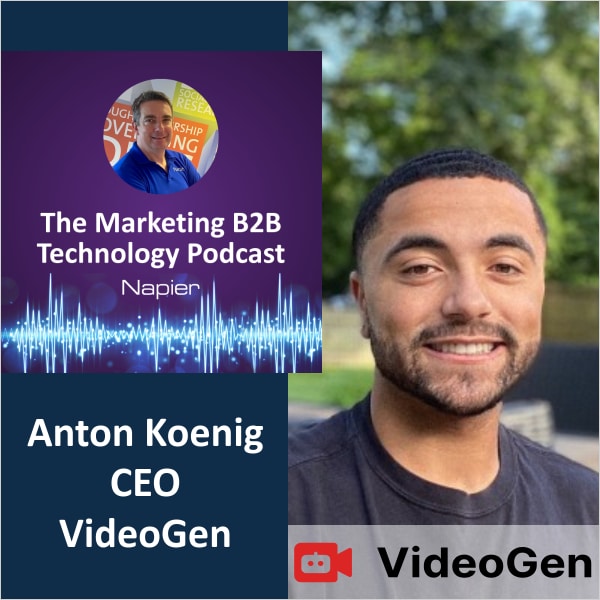
Harnessing AI for Video Editing: Insights from VideoGen's CEO Anton Koenig
Anton Koenig, Co-Founder and CEO of VideoGen, an innovative video editing platform that utilizes AI technology and highlights how AI now supports semi-professionals and professionals in producing high-quality video content.
Anton emphasizes the importance of combining AI-generated content with user-driven editing to enhance video quality and engagement. The episode also covers common mistakes marketers make in video production and offers insights into the future of video content creation.
- Marketing B2B Technology on Apple Podcasts
- Marketing B2B Technology on Spotify
- Marketing B2B Technology on napierb2b.com
About VideoGen
Founded by Anton Koenig and David Grossman in their college dorm rooms, VideoGen has grown to over 4 million users across 190+ countries. They are backed by the world’s top early-stage investors including Y Combinator and Rebel Fund. As video becomes the dominant form of communication, their mission is to democratize video creation with AI, helping millions express themselves and share ideas in the process.
About Anton Koenig
Anton Koenig is the co-founder and CEO of VideoGen. He previously interned at Amazon Web Services and left the UMass Amherst Computer Science program to build VideoGen full-time. He began freelancing in graphic design in middle school, which led to video editing, web design, and ultimately web development.
Time Stamps
00:00:41 - Anton's Background and the Origin of VideoGen
00:04:36 - Current Features and Functionality of VideoGen
00:10:15 - VideoGen's Impact on Marketing Strategies
00:11:59 - Common Mistakes Marketers Make with Video
00:13:36 - Balancing Quality and Quantity in Video Production
00:16:22 - VideoGen's Marketing Strategy and Promotion
00:17:56 - Future of Video Creation and AI Integration
Quotes
"The mistakes that we see is not copywriting themselves, just totally trusting the AI to write for them." Anton Koenig, CEO at VideoGen.
"The main driving force for more demand for video is that the cost to stream video is going down and that more people's devices are supporting video." Anton Koenig, CEO at VideoGen.
"Creating videos is like a super important skill now and not a lot of marketers know how to do it." Anton Koenig, CEO at VideoGen.
Follow Anton:
Anton Koenig on LinkedIn: https://www.linkedin.com/in/antonckoenig/
VideoGen website: https://videogen.io
VideoGen on LinkedIn: https://www.linkedin.com/company/videogen/
Follow Mike:
Mike Maynard on LinkedIn: https://www.linkedin.com/in/mikemaynard/
Napier website: https://www.napierb2b.com/
Napier LinkedIn: https://www.linkedin.com/company/napier-partnership-limited/
If you enjoyed this episode, be sure to subscribe to our podcast for more discussions about the latest in Marketing B2B Tech and connect with us on social media to stay updated on upcoming episodes. We'd also appreciate it if you could leave us a review on your favourite podcast platform.
Want more? Check out Napier’s other podcast - The Marketing Automation Moment: https://podcasts.apple.com/ua/podcast/the-marketing-automation-moment-podcast/id1659211547
Transcript: Interview with Anton Koenig and VideoGen
Speakers: Mike Maynard, Anton Koenig
Mike: Thanks for listening to Marketing B2B Tech, the podcast from Napier, where you can find out what really works in B2B marketing today. Welcome to Marketing B2B Technology, the podcast from Napier. Today, I'm joined by Anton Koenig. Anton is the co-founder and CEO of VideoGen. Welcome to the podcast, Anton.
Anton: Thank you for having me, Mike.
Mike: It's great to have you on. We like to learn a little bit about our guests first. So maybe you can tell me a little bit about your career and why you decided that you needed to find VideoGen.
Anton: Sure. The story behind VideoGen started actually way back when I was in middle school. That's when I met my co-founder or now co-founder. We're in a tennis academy together and we were actually doubles partners and competitors. So we became friends through tennis. And at the time, there wasn't a lot of middle schoolers interested in programming and building web apps and also video editing and graphic design and sort of digital creation. So we also became friends over this shared interest. And we worked on some web applications together. I built like a small social network. He built, I remember it was, uh, like an online music editing software. And we just launched a bunch, a bunch of small apps, sometimes working together and sometimes just sharing ideas. And we always wanted to build something that would have been useful to us kind of back in the day when we were just starting out, figuring out how to create stuff online. So. Fast forward to 2023 or 2022 actually, late 2022. Him and I are still in college, but we're, you know, kind of nearing the end of college. We've gone through the big tech internships. And we sort of realized that that's not like the direction we wanted to go of like working at one of the fan companies as a software engineer. We wanted to build a startup, build something that we're passionate about, that we could talk to our users and see the real impact of. So we just started brainstorming a ton of ideas. If you remember, this was right before ChatGPT had launched, but there was OpenAI had released a GPT-3 and they had like a sort of a private platform that we were lucky to get off the wait list early. So we were like one of the first people to get access to GPT-3. And we were using this model. We were trying to start a company. David was actually working at, he was interning at this video editing startup. I was working with, I had kind of a web design thing at the time. And we were like, okay, video editing is something that we understand. It's something that, you know, we've done before ourselves and we understand the technology behind it. And we saw that using the models like GPT-3, we can actually make it a lot more accessible for the average marketer, the average communicator or educator, where certain tasks are just very tedious right now, where you have to manually source stock footage, you have to manually record voiceovers, you have to go inside of the timeline and organize all your layers in extreme detail. and the state-of-the-art video editors of the time, and still today, will have just so many buttons all over the place. It's very overwhelming. So there wasn't like one aha moment where I could point to to say, okay, this is when we had the idea for VideoGen, but we were in the midst of brainstorming. We saw this opportunity with GPT-3, And we decided to just sit down for six months and work on the first version of VideoGen, which we launched in 2023.
Mike: That sounds, I mean, really exciting. Lots to ask about, but I mean, maybe the best thing is to talk about, you know, what's happened between 2023, when you created this video editor using early versions of ChatGPT and what VideoGen does now. So can you give us a little explanation of what VideoGen can do today?
Anton: So the biggest difference between what we initially did and what we do now is that we actually support all of the video editing functionality you would expect, but the AI still can create your first draft. VideoGen 2023 was very simple. You know, you would sign up and then you type in a little prompt. it would find stock footage for you, it would generate a narration, and then it would put everything together in a video. But once you had the video, you couldn't really edit it. So this worked for some very small creators or people that are extreme beginners. But today, we serve semi-professionals and professionals who will use AI to get their first draft. It'll bring them 75% there. And then they'll go inside of the editor and refine all of the small details. And we find that that's sort of the best balance, where similar to if you use a template, it's sort of much better to use a template or now this AI-generated version than it is to build something completely from scratch. But with AI, the video that we create for you is much more unique, and we have The main workflow that our users do today is they'll type in a prompt, it'll write a script for them, they'll edit the script, and then they can also refine the layouts on the side, so it's sort of like a wireframe storyboard. And then you submit the script, and it's going to find and source stock footage or AI-generated footage and clip it in place. It's going to create an AI narrator or an avatar, which is more common in a communication content. And then it will also find like music and captions and all the things you'd expect from a video. So that's kind of the most popular workflow. The main way we've evolved is just by adding more editing features and more professional tooling.
Mike: And so I guess, you know, the big difference between VideoGen and maybe some of the large AI models is that you're adding this editing feature. So that presumably is still the critical bit, particularly if you're looking, for example, as being a professional marketer and you need a video to be perfect. Is that right?
Anton: Definitely. I will say so. A big reason that we actually decided to add these editing features is we started using VideoGen internally for our own marketing and we realized okay, this is super cool, but in order for it to actually be useful, we need to be able to do things like, you know, add our own brand colors with like our own CTA at the end in a very specific format, right? Or we need to be able to change like this one line of copy to, you know, just sound a little bit different so that we can A-B test. So it's things like that, which without having those like really standard now, video editing functionality, it's pretty difficult to use in a professional setting. If you see like ChatGBT, or I know like if you go to Bing now, they'll have like a create video button. A lot of those tools are much more consumer facing. So they're not going to offer any of the video editing functionality. But if you want like a very short clip, and that's all you need, then they're great for that.
Mike: And so, I mean, who is it who's using VideoGen? You kind of alluded that the consumers can probably get that, a lot of what they need free of charge. So, I mean, is this enterprises? Is it marketers? Where do you see the biggest group of users?
Anton: Yeah. Right now we focus on semi-professionals or prosumers. So this is pretty wide range. But our largest segment is marketers and semi-professional marketers who maybe their job title isn't marketer, but they end up having to do a lot of marketing. You know, huge range within that. We'll see B2B marketers, B2C marketers. Yeah. You'll see like content creators who are trying to build an audience to sell a product. Another large segment is training and communications and like corporate education, where there it's a lot more like slow paced content. People are creating five to 10 minute videos trying to educate on a topic. And then the list kind of goes down from there. So marketing, Communication, education, we sort of grouped that together because the video formats are similar. And then it's content creators, consumers just trying to play around with the latest tool. We have some media companies actually. It's one of the largest media companies in the world uses us as well. So one of the exciting things with video is that So many different people are using video for so many different things. And we actually couldn't have expected that when we first got into VideoGen.
Mike: I mean, I totally agree. A lot of marketing is about video now. It's a huge move to video. I mean, is there an area that you see people particularly getting benefit from VideoGen in the marketing space? Is it around social or something else?
Anton: Yeah, mostly paid social. I would say that's typically where you have like the most constraint on video production for context. Like when we were running our paid social, we would produce like between 10 and a hundred creative assets a week and a certain percentage of those we want it to be video. So producing that is just impossible now with a human, right? You need, people to create certain assets, and then you need platforms like VideoGen to repurpose those and create different variations that you can maybe test. We also see a lot of organic marketing, which some of it has been surprisingly successful. The reason I say that is the videos that VideoGen produces now they're still like relatively formulaic, like more for an ad or like a training video. And our thought was that with organic content, you sort of need to have like a person talking engagingly in front of the screen. But we have seen a few channels grow their audiences to 10,000 or, you know, 50,000 or 100,000 subscribers. And then they'll sort of sell a product on the back end of that. But I think paid social is where we see the best recurring use case right now.
Mike: One of the things I'm interested is, as marketers, we're all getting to grips with videos, and particularly in B2B, my sector. It's a relatively new thing to have to generate all this video. I mean, what are the mistakes that marketers make when they're trying to generate video?
Anton: The mistakes that we see is not copywriting themselves, just totally trusting the AI to write for them. It's a little bit counterintuitive because the whole idea is that the AI is going to do the work for you, right? But there's sort of a balance where the AI is going to give you that first draft. It's going to make it so you don't have to write something completely from scratch and spend an hour just getting started. But the best marketers are still going to go in. They're still going to make the small tweaks, you know, change the phrasing of this, that intro hook sentence to just be a little bit more engaging or make this part a little more concise. Like it's just small edits that make something really engaging and professional. And even though we, you know, LLMs have gone really far, you still need a marketer to go in and write copy. That's like really engaging and true to the brand. So yeah, I'd say the biggest mistake is not doing like those few basic edits to take the video from like, okay, to, okay, now it's like super professional and engaging.
Mike: And that's very interesting, because I think a lot of people are talking about volume when it comes to AI, you know, AI's great strength is speed. But actually, it sounds to you, to me, like you're saying with video, quality is probably the important thing. And spending some time up-leveling that quality is more important than producing a 51st video.
Anton: Well, so I'll put a caveat here. This is more of the mistake that we see with our users, who, if we look at the average marketer working with video, The average one is spending hours or sometimes days per video. Whereas our average user is producing a video in five minutes or less. If you try the platform, it's like the first video is like 15 seconds on average. So that can train some of our users to go like a little too fast. I don't think it's good to spend five hours on a video if you're trying to run a marketing campaign, especially on paid social, where you need like a large volume to AB test. I also don't think it's good to spend 15 seconds on a video. So I think there's an ideal of like, okay, I'm going to spend 30 minutes editing this up, refining it. And then I'm going to move on to the next one. And then at the end, we'll have a package of like 10 videos that we can use for a campaign.
Mike: And what about the way you generate video? I mean, should marketers be using a combination of video they shoot themselves, stock, and also AI generated? Or is it better to focus on one particular source?
Anton: I think it depends a little bit. We're usually mixing, I mean, our users will usually not mix stock and the AI generated footage. they'll usually use either stock plus uploaded assets or they'll use a fully AI generated footage. I don't know if there's a hard rule on that. I don't think that you can succeed with a mix. Like one of the things that people will do is they'll use maybe stock footage for 99% of their video. And then if there's like one missing clip, they'll generate an AI clip. Yeah, I think it depends. One thing we've seen work for us when we would create ads is we would mostly use, I mean, cause we're a software company. So the types of assets that we needed were recordings of people using the software or it would be like a motion graphic of the software. So it's something that you can't find in stock footage or generate really with AI. So what we would do is we'd upload our own clips of the motion graphics or the screen recordings. And then we would use that for the whole like back half of our video. But our like first hook just to grab the user's attention would be an AI generated clip. So it would be like an engaging hook. AI-generated effect that's something that you could never imagine creating without an animation team. And then it switches to the pre-made assets that we've created.
Mike: And it's interesting you talking about the assets you make, Anton, because presumably your marketing strategy is built around showing the capabilities of the product by making videos. Is that how you do it? And how do you promote that?
Anton: So right now, most of our, we're not really investing in so much marketing right now. It's pretty much all word of mouth. But there was a period, especially when we were starting, we were investing pretty heavily on all the popular platforms, you know, Meta, Google. We actually didn't do TikTok, but YouTube. And we found that It's sort of a mix. A lot of the best ads for us were just people that were looking for video production software. So they didn't necessarily go to like a video platform like Facebook or like Instagram reels to find that. Maybe they would go to YouTube. and then they would search. So then it would sort of be like a tutorial video or like a more helpful video that guides them and then also converts them. So it's sort of, I guess like long form video for us was more successful.
Mike: No, that makes a lot of sense. I'm interested, you know, let's talk about the product specifically. What do you see happening with, you know, video? It's doing things today that probably people didn't imagine five years ago. So how do you look for the future? And how do you, you know, think about what the features of VideoGen might be in five years time?
Anton: Yeah, so I think our strategy, which has been since day one, is we're just going to focus on the immediate pain points of our customers. And if we just do that every day, every month, every year, and continue to deliver value, then we shouldn't have to think too deeply about what is the grand economic trend here. I think that it's going to depend a lot per industry. So it's hard for me to give like a very kind of concise answer. It's a question I get a lot, like what is the future in five years look like for AI video creation? I think for marketers specifically, there's just going to be more demand for video. And that's something that we've already seen over the past five years and 10 years. And I actually think the main driving force for that is that the cost to stream video is going down and that more people's devices are supporting video and that the cost to produce a video is going down. I think AI is an accelerating force for that, but I actually don't think that it's changing like the fundamental trend, which is that you know, 10 years ago on a lot of devices, it's actually pretty difficult to, like, you couldn't imagine something like TikTok, where you could just scroll through a bunch of one minute videos forever and never really have to worry about lag or bandwidth. We had Vine, which was limited to It was like six seconds. And then they shut it down because they were losing money because the storage costs were so high. So the technology industry in general has made like a ton of advancements on storage, on video encodings. And I think AI is just an accelerator for that. So more people are going to be watching videos. More people are going to be creating videos. And that's going to lead to more competition. So you need to like the quality bar definitely goes up for all the creators. It's also going to lead to a lot of interesting trends and memes and viral clips that like right now, I mean, we sort of got like one viral clip or one meme per year, maybe two. But as people consume more and more video, I think that there's going to be like many, many pockets where you have these like trends pop up. And yeah, it just leads to like a lot of quick motion in these in these consumer markets.
Mike: Yeah, it sounds really exciting and I'm sure people will be interested to try the product as well. Before we talk about that though, there's a couple of questions we'd like to ask everybody who is a guest on the podcast. So the first question, Anton, is about advice. And it's what's the best marketing advice that you've ever been given by someone else?
Anton: The best marketing advice? So this is always a tough question because I don't want to give broad advice, especially, you know, our platform is pretty unique. Like most of our customers who are marketers, they have different challenges than what we have marketing our product. So that's just the nature of being like an AI software company. There's only so many companies like us. best marketing advice? Yeah, that's a tough question. I don't know if I can think of like one specific example, I guess. Yeah, just provide value, like value-driven marketing. It's not like one piece of advice, but there's definitely like a whole ecosystem of how do you give value upfront to then convert that into a customer later? And we've definitely seen that work on our end. with not just like content, but also with the product itself. Like, you know, if we give a little freebie, like you can get a free video or you can get some free AI credits, then that helps us build trust with the customer. And then they're much more likely to convert and stay later on. Yeah, I can't point to like one specific quote, though.
Mike: No, but I mean, I love that idea of making sure you give value. I think that's great advice. The other question we ask is, if you were talking to someone who was, for example, a graduate just entering marketing, what would you tell them to help them grow their career?
Anton: So there, it would definitely depend on the type of marketing they're interested in. That's kind of the first question I would ask them. Yeah. I mean, probably the most important thing is like that you're doing something that you're passionate about and that you can do for a very long time. So yeah, let's say I'm trying to like imagine a certain type of marketer. I mean, I would definitely tell them to learn how to create videos. You know, creating videos is like a super important skill now and not a lot of marketers know how to do it. And it's becoming easier, but it's still pretty hard and you still do have to know how to edit. So I would tell them to learn how to create videos. I would tell them to understand how I guess SEO works on like a very detailed level. I guess that's one thing where David and I, David's my co-founder, us having been programmers and building a lot of websites, we have like a good understanding of how search engine works and how they discover your platform. And we find that those same principles are sort of getting reapplied, even as we see things like chat GBT come onto the market. You still have the same principles of how does like a program look at your software and your website and try to index it.
Mike: Yeah, that's awesome. Thank you, Anton. Really, really useful advice. Before we finish, I'm sure people are listening to this and they're thinking, you know, I want to try VideoGen or maybe they've got some questions. So where's the best place for them to go to find out more information?
Anton: The best places probably are just our website, videogen.io. And you can also just look up VideoGen and it should show up. Yeah, you can sign up for free and try it. We do have for some like larger customers, if you're interested, you can find, we have like a, on our pricing page, a contact sales button, but I recommend that people just try it for free and see if you're interested.
Mike: I think that's great. That's a real confidence in the product to say, try it. And then if you think it's a good product, then contact us. So that's awesome. Anton, this has been really interesting. I know a lot of marketers, particularly in B2B, are worrying about how they can generate more videos. So thanks for explaining how VideoGen can help.
Anton: Yeah, and thank you, Mike, for having me.
Mike: It's been a great conversation. Thanks for being a guest on Marketing B2B Technology. Thank you. Thanks so much for listening to Marketing B2B Tech. We hope you enjoyed the episode. And if you did, please make sure you subscribe on iTunes or on your favorite podcast application. If you'd like to know more, please visit our website at napierb2b.com or contact me directly on LinkedIn.

5 Things To Consider Before Recording Podcasts
Over the last few years, customers have been spoilt for choice when it comes to ways of consuming content. No longer does the consumer have to wait for press releases and news websites to keep up to date with their favourite company or customer. The rise of Social Media networks like Facebook, Twitter and Instagram have played a big part in changing the way people can consume content. Over the last decade, YouTube grew to become the second largest search engine, empowering companies and creators to develop video content targeted at their subscribers or anyone with the same interests. Fast forward to 2021, and podcasts have become one of the best forms of consuming content and learning about businesses.
Whether it’s during a commute to work or relaxing at home; podcasts have become the ideal tool for companies to showcase their brand and partners in an engaging conversation tailored for specific target audiences. Compared to other forms, content like video and podcasts offer less hassle, stress and privacy because the presenter and the guest don’t have to constantly look and act perfect on camera; they can loosen up and be more sincere over a cup of coffee and have a conversation with a set of microphones. Podcasts are more versatile and can be consumed anywhere in the world whereas video can have restrictions. The investment from Spotify, Apple iTunes and other audio streaming service providers has also helped to stimulate the growth of podcasts, boosting awareness and reaching wider audiences. With the evolution of podcasts, we have put together a list of 5 things to consider before you start recording.
Planning
Before any recording takes place, it is important that the interviewer or company hosting the podcast defines the goals and objectives of the podcast. Following this, a brainstorming session needs to take place discussing the key topics the podcast needs to cover to meet the objectives. It is also advised to have a structure and script laid out to help with the flow, to stay on topic and on time.
A podcast presenter needs to be chosen followed by a shortlist of companies to be approached to do the podcast interviews with. If multiple episodes are being planned, it is important to have guest speakers confirmed before any of the recordings commence. That way the whole series of podcasts can be recorded in the desired time frame and launched in accordance. It is also worth having one or two guests as backup in case any guests cancel.
Find your USP
It’s no secret that as more and more podcasts emerge, it is important to stand out from the crowd. Finding your unique selling point is crucial to help gain traction and retain your audience. Whether is your presentation style, questions, guests, topics covered, interaction with the audience, competitions etc, it is vital to identify what others are doing and how to improve on that and be authentic.
Understand your audience
Who are we trying to target? Where are they located? Why should they listen in? What message are we trying to convey? How are we going to measure the success from our audience? These are some of the questions you should know the answers to. With podcasts, it’s about building a community, and knowing what the target audience want to keep them engaged.
Setup
The podcast setup is just as important as the podcast itself. You need to make sure you have good quality microphones, headsets, recording and editing platform. The podcast presenter and guest need to ensure they are in a quiet room that doesn’t echo, with no background noise, and a good internet connection/WIFI. Audio testing is also an important part of the setup, to check quality and audio levels.
Consistency is key to success
Once you have recorded the first series of your podcast, it is important to look forward to the future and start planning on the next series. Consistency is key to keeping your audience engaged and coming back for more. Podcasts present a brilliant opportunity to not only build communities but entice new business opportunities.
For more information on how we can support you launch your own podcast, please do get in touch.

How a Social Media Scheduling Tool Levelled-Up Our Game
Although the last 14 months has proved to be a challenging time for businesses across the globe, social media was an essential communication tool in keeping businesses and audiences connected. In some instances, social media became the main form of communication between a business and its customers. With travel restrictions in place and no live audiences allowed, through social media businesses were able to connect with their audience, by hosting live global launch events through Facebook and Instagram lives. More than ever, social media was used as a key strategy to launch new products, a key source to drive traffic to webinars, podcasts, surveys, virtual training courses, virtual exhibition stands and more. Social media scheduling tools have become critical to plan ahead and create content calendars.
In this blog, we explore the benefits of a social media scheduling tool, why Socialbakers should be the scheduling tool of choice for your business and how it can help B2B marketers boost their social media strategies.
Benefits of a scheduling tool
Benjamin Franklin’s quote, “If you fail to plan, you plan to fail” is often a cliché quote but when it comes to social media, planning your content really is the key to success and growth. One of the many benefits of a social media scheduling tool is that it enables businesses to streamline workflows to allow for greater efficiency and capacity utilization. Users of the tool can reach their desired target audience at the right scheduled times, increasing consistency, and flexibility whilst also saving time in the process. A social media scheduling tool enables B2B marketers to take a strategic approach towards their social media plans based on the reporting functions that these scheduling platforms offer. Scheduling tools eliminate the need to post randomly and enable users to compare what works and what doesn’t.
Checklist for selecting a social media scheduling tool
Prior to selecting our social media scheduling tool, we adhered to a strict checklist to help select the best platform. The tool had to offer the following solutions:
- The ability to schedule posts
- Allowing clients or people internally to review and approve posts
- Providing quick and easy reporting tools
- Listening for mentions of the brand or keywords
- Providing competitive analysis (seeing what competitors are doing)
- Enabling advertising/sponsoring of posts
- Optimize time spent on social media
Scheduling posts is not always a straightforward process. A seemingly simple task can often become complicated based on the functionality and ergonomics of the social media scheduling platform. For example, some platforms do not allow for videos to be scheduled or would only schedule a video if it were of a certain size. Likewise, a key feature we looked for was enabling clients to approve scheduled posts including the video/picture assets used and request for changes if the client was not happy. Giving the client control whilst also being user friendly was key to our decision making.
Importantly, a key feature the platform had to offer was for easier and quicker reporting. Rather than manually counting likes, video views, impressions etc. by using spreadsheets; a social media scheduling platform that could calculate the stats in real time at the touch of a button was essential. One of the many disadvantages of manual reporting is that as soon as the report is completed, the stats are already out of date as the content continues to perform and statistics evolve as more people engage with it. Having the ability to get statistics at any time and regularly was important to enable us to take our social media game to the next level.
Why we signed for Socialbakers
Before deciding to go with Socialbakers we approached more than 12 different platforms including Hootsuite, Buffer, Sprout Social, Loomly, Bytraject, Contentstudio, Locowise, Agorapulse, ContentCal, Crowdfire and Sendible. All had their advantages, disadvantages, and unique selling points. However, we believed Socialbakers was the best platform that met our criteria because of its complete all-round package especially in reporting and analytics.
Socialbakers is a platform that enables us to manage multiple social media profiles in one place from publishing and scheduling posts in advance, to tracking analytics across platforms, analyzing what competitors are posting and more. This AI-powered social media and digital marketing suite is one of the best scheduling platforms supported by data insights that helps us to work smarter. Supporting LinkedIn, Twitter, Facebook, Instagram, YouTube, Pinterest and Vkontakte, they offer deep performance analysis and competitive benchmarking. We can compare content performances against ourselves, competitors, along with the wider industry.
Socialbakers offers the following functions:
- Approval workflows
- Social Listening tool
- Detailed data insights with performance metrics
- Ads Benchmarks & Video Benchmarks
- Content calendar and Multi-platform Publishing
- Using AI recommendations, it suggests which content to promote
- Paid content analytics
- Community management
What it lets us do
This platform enables us to analyse our own multichannel performance across organic and paid social media platforms and report the data accordingly to improve. The tool allows us to easily repurpose content based on performance without having to find the visual assets. We can search content from over a year ago by filtering it on date and then likes, reactions, interactions, shares/retweets, video views or best performing posts on the platform, and then reuse the same content with the same visual assets, saving considerable time.
The platform can search and track influencers, compare the performance of organic posts vs paid/sponsored posts against the industry or any country you desire to assess where your company stands in the market. When it comes to publishing new content, it's easy and intuitive. It offers the opportunity to label posts and assign them to a certain campaign so you can track it when reporting. Any new content published along with the videos and pictures are stored on the platform so that in the future, you never have to go looking for that video or picture that could be saved on a different computer or a colleague’s laptop.
Socialbakers has an impressive configurable cross platform dashboard where we can analyse data from every angle on every platform across multiple campaigns. It allows us to set up specific metrics including the number of interactions, posts, response rate, sponsored content click through rates, sponsored content clicks, sponsored content cost per click and more. The dashboard can also be synced with the client’s Google Analytics to further optimise reporting. We can monitor the performance of live posts as well as the top performing posts in a specified time frame.
The tool has a social listening function using keywords to monitor competitors, brand and market insights. This can be a great way to understand what people are saying about our brand. Additionally, we can respond to messages from other social media platforms all within the tool, reducing the time needed to login to native social media accounts to respond to messages. The tool also features an inspiration section, where we can search for various top performing posts online across different industries that are performing well based on our keyword entry. We can then repost this content and assets with a click of a button. You can also create a collection board with post ideas and get clients or colleagues to vote on whether they like the ideas or not.
Finally, the tool features a paid section, whereby users can access, analyse and compare the performance of paid campaigns. Users can get paid analytics for LinkedIn, Facebook, Twitter and Instagram. Marketers can also sync Google Analytics with the paid analytics section, so all the data is on Socialbakers.
How Socialbakers levelled-up our game
Socialbakers has enabled us to start using reporting data to determine our content direction and decisions. Analytics forms the basis of our strategy, looking at what performed well and the time it was posted which guides us in the right direction in content planning.
We currently use Socialbakers for several clients, but our analysis indicated that videos are still the best form of content on their LinkedIn and Twitter pages. Over a specified period, videos continually brought in the most engagement, likes, shares and comments. In particular, the more honest/raw and less polished the video was that got straight to the point, the better it performed. The trends we analysed through Socialbakers also revealed that catchy and interactive captions with emoji’s and hashtags performed better than long informative captions. Campaigns that worked had engaging visual assets which included images, GIFs, and videos.
The social media scheduling tool also allowed us to analyse the worst performing posts and assess trends thanks to its brilliant dashboard. Our reporting highlighted that repetitive content with the same creative assets, or content with just text and no preview images or thumbnails did not perform as well as the others. Although content can sometimes be unpredictable and varies from one account to another, Socialbakers provided the assurance with impeccable granular data to keep us on the right path to achieve our social media goals for the client. Not all content posted through this platform will be a success.
Socialbakers has empowered us to move away from traditional workflow systems like spreadsheets to a more flexible, efficient, and user-friendly system. Previously we would have duplicated the work by creating content in a spreadsheet and then copy and pasted it into a scheduling tool, but now everything can be done on the platform. Clients can approve social media content at the click of a button, seeing all the visual assets together with the post. Previously, clients would have had to review the text, then click a link that takes them to a separate page to view the video and then go back into the spreadsheet and repeat the process for every post. Now everything is visible in the content calendar and approval takes minutes.
Request a demo today
Socialbakers has been a welcome addition to our company to aid us in effectively managing client’s social media profiles. Social media management can be time consuming, complicated if not managed correctly and become a missed opportunity. It is important to use the right tools to make the most of your social media content to ensure the best return on investment. Please feel free to get in touch via email or telephone and we would be happy to discuss and show you how Socialbakers can improve your social media marketing.